Guides & Tutorials

Articles and video tutorials to help you get the most out of plain-text note-taking with Notegrity — from organizing your notes to building workflows that stay simple, portable, and entirely your own.

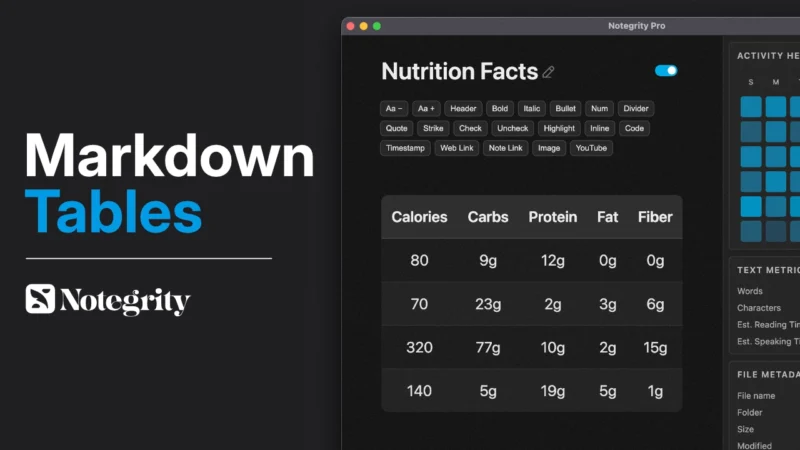
How To Make Markdown Tables with Plain Text Syntax
How To Create Markdown Tables with Plain Text Syntax
How To Create Markdown Tables with Plain Text Syntax 1024 576 Notegrity

In this tutorial you’ll learn how to make markdown tables using nothing but plain text syntax. This lesson utilizes a standardized markdown…

Encryption Specifications
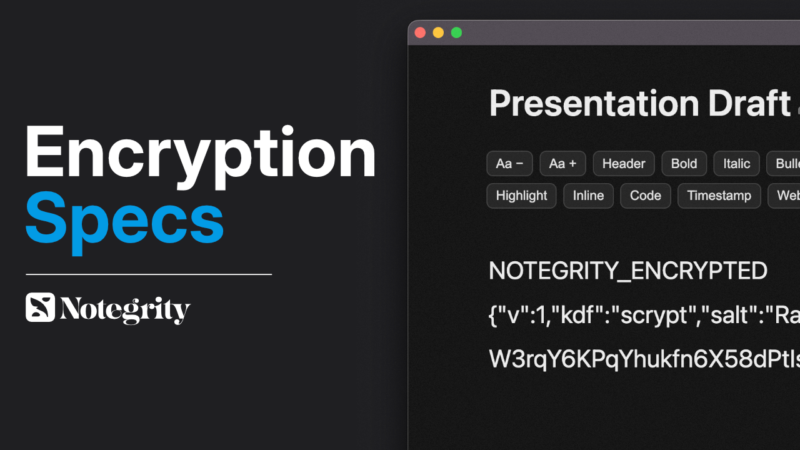
Notegrity Encrypted Note File Format Specification
Notegrity Encrypted Note File Format Specification 1024 576 Notegrity

Version: 1.0 Applies to: Notegrity encrypted notes Last Updated: 2026 1. Overview Notegrity encrypted notes use open, industry-standard cryptographic primitives and a human-readable container…

Notegrity Starter Guide
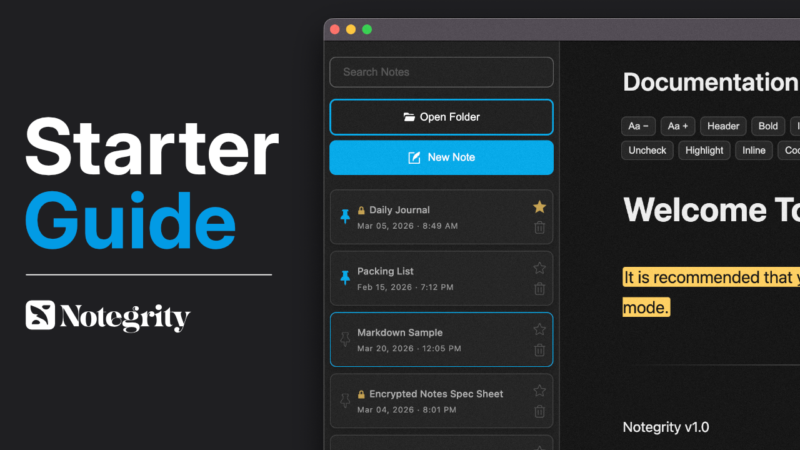
Notegrity Starter Guide | The Plain Text Note-Taking App
Notegrity Starter Guide | The Plain Text Note-Taking App 1024 576 Notegrity

Notegrity is a plain text note-taking app that acts as a front-end for the files on your local system. It was built for…

Frequently Asked Questions

Notegrity is for the privacy-conscious user who prefers simple, local note-taking without accounts, subscriptions, or vendor lock-in.

If you've ever had to export thousands of notes because an app raised prices or shut down, Notegrity is for you.

Notes created in Notegrity are files that you own and are saved in interoperable formats that work with countless other note-taking apps, text editors, and terminals.

Notegrity is an offline tool that lets you own your notes as individual files in standardized, interoperable formats. It does not require an account and it does not collect or transmit your data.

Most modern note-taking apps collect analytics or telemetry to measure usage, track feature adoption, or monitor behavior. While this data may be anonymous, it still means the app is sending information about how you use it back to the developer.

Notegrity takes a different approach. It does not include analytics, telemetry, or usage tracking of any kind. The application never sends information about your activity, your notes, or your system to external servers. In fact, it doesn't even have the ability to. Everything stays on your device, under your control.

Furthermore, Notegrity is a true plain-text note-taking app that works with TXT files. Other note-taking apps may store notes in plain-text formats, but their editors are usually markdown-based. Notegrity keeps the editor plain text and provides markdown rendering as an optional layer for those who want formatting without sacrificing the simplicity and versatility of plain text.

Plain text is the most timeless and reliable way to store words.

Plain text is universal and non-proprietary. It doesn't require any special editors, ecosystems, platforms, and there’s no DRM baked into it. Your notes are readable wherever files are readable, which is everywhere.

Plain text doesn't break with software updates. If the file exists, your note exists.

Plain text is copy & paste-friendly. It doesn’t drag fonts, weights, or styling along with it. It assimilates into any environment in which you paste it. Plain text is the raw ingredient on your cutting board that isn't flavored until you throw it in the pot with the other ingredients.

Plain text comes in small file sizes. It's easy to store, copy, transfer, and back up.

Plain text respects your future self. Modern note-taking apps assume that they’ll be around forever and you'll be invested in them forever. Plain text assumes the opposite. Your tools will change, but your notes shouldn’t.

Most importantly, plain text is ownership. The further away you move from plain text, the further you are from owning your notes.


Notegrity is a local-first tool for self-hosting your notes. Note files are stored directly on your computer as .txt or .md files.

When saving notes, you choose the folder where they live. Many users create a dedicated notes folder so it’s easy to sync or back up.

Yes, you just have to open the folder where they're located and they'll be loaded into the Notegrity sidebar.

Absolutely not! Notegrity is an offline tool that was designed to function like a system utility. It does not collect any data about you or your note contents whatsoever. Metrics in the Insights panel are calculated locally on your device and updated in real time. What happens in Notegrity stays in Notegrity.

Notegrity treats your notes as regular files that you own, meaning you would sync them the same way you'd sync any other folder on your computer. You can use tools like Dropbox, iCloud, Syncthing, or Nextcloud — whatever you prefer.

No. Notegrity runs locally and works directly with files on your computer.

Notegrity is not currently open source. However, the application is built around open and interoperable file formats such as plain text and Markdown. Your notes are never locked inside a proprietary system and can always be accessed with other tools.

Yes. Notegrity Pro is not a cloud service and it does not rely on servers or online infrastructure to function. It doesn't even require an activation key to use. Once the application is installed on your computer, it will continue working regardless of what happens to this website or the business behind it.

It's no different than purchasing a hammer from a hardware store — it's a tool that you own and cannot be taken back.